Introduction
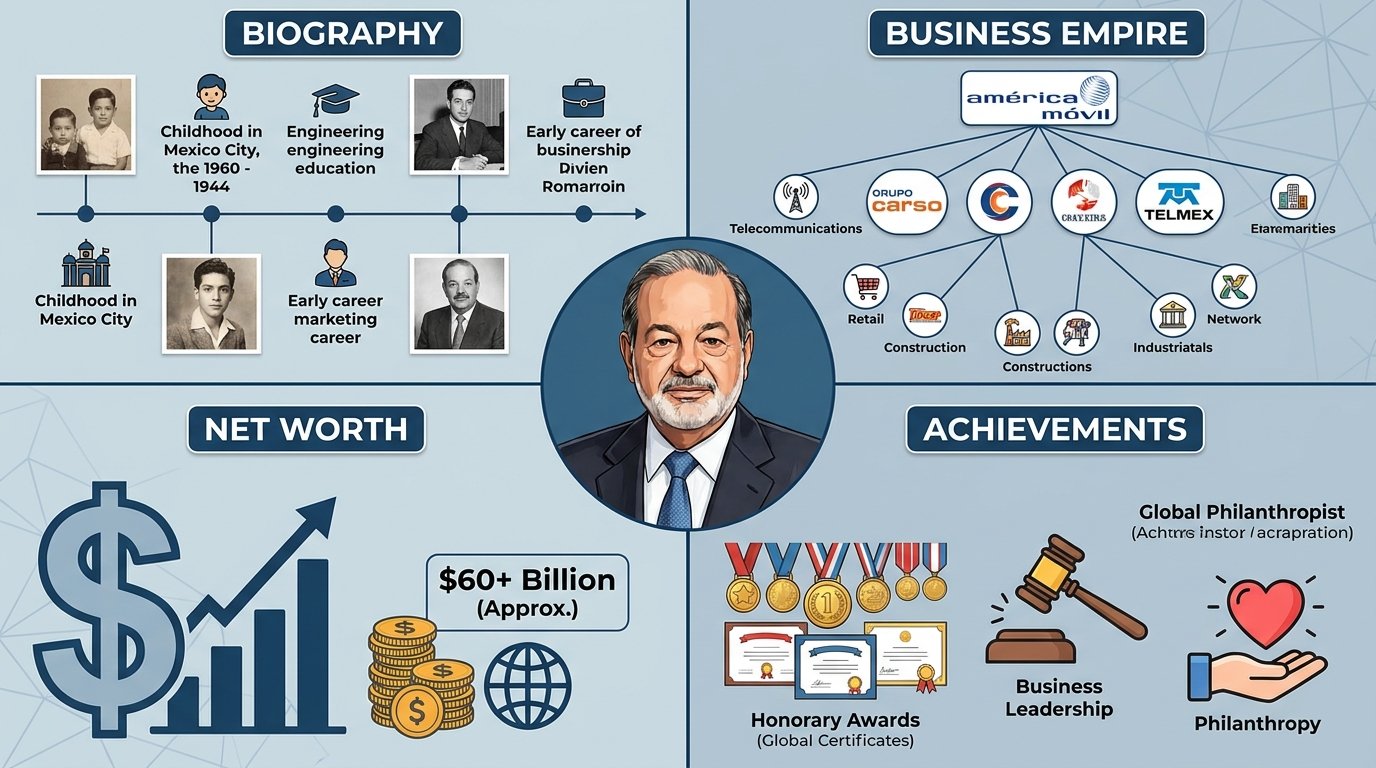
Carlos Slim Helú stands as one of the most transformative industrial, financial, and telecommunications magnates in modern economic history. Emerging from the commercial environment of early twentieth-century Mexico City, Slim built an enterprise that spans telecommunications, retail, industrial manufacturing, civil construction, banking, insurance, energy, and infrastructure. His holding companies—chief among them Grupo Carso, América Móvil, Grupo Financiero Inbursa, and Impulsora del Desarrollo y el Empleo en América Latina (IDEAL)—have integrated themselves so deeply into the fabric of the Latin American economy that business analysts often refer to Mexico as “Slimlandia.”
At the zenith of his global financial valuation between 2010 and 2013, Slim surpassed American business icons Bill Gates and Warren Buffett to become the richest individual in the world according to the Forbes and Bloomberg billionaire indices. This marked the first time in over a century that the world’s highest net worth individual came from a developing economy rather than the United States or Western Europe. His career challenges traditional models of capital accumulation, demonstrating how value investing, counter-cyclical asset acquisitions, operational efficiency, and structural modernization can generate sustained growth across emerging markets.
Slim’s overarching philosophy rejects short-term speculative financial maneuvering in favor of long-term capital compounding, rigorous cost control, and continuous reinvestment. By democratizing cellular communications through prepaid business models and modernizing critical infrastructure across the Western Hemisphere, Slim has reshaped how commerce, communication, and financial services operate across Latin America.
Early Life, Family Background, and Foundational Roots
Lebanese Immigrant Heritage: The Helú and Slim Families
Carlos Slim Helú was born on January 28, 1940, in Mexico City, Mexico. His origins trace back to Jezzine, a mountainous town in Ottoman-controlled Lebanon. In 1902, his father, Khalil Salim Haddad Aglamaz, emigrated to Mexico at the age of fourteen to avoid forced military conscription into the Ottoman Army. Upon arrival in Mexico, Khalil Hispanicized his name to Julián Slim Haddad.
Julián Slim Haddad settled in Mexico City and integrated into the city’s Lebanese-Mexican commercial community. In 1911, alongside his older brother José, Julián established a dry goods store named La Estrella de Oriente (The Star of the East) on Calle de Capuchinas in downtown Mexico City. By May 1914, amidst the turbulence of the Mexican Revolution, Julián bought out his brother’s share to become the sole owner of the thriving mercantile business.
In August 1926, Julián Slim married Linda Helú Atta, the daughter of Lebanese immigrants Wadih Helú and Wadiha Atta, who had arrived in Mexico at the end of the nineteenth century. Linda’s parents had established the first Arabic-language printing press in Mexico. Together, Julián and Linda had six children: Nour, Alma, Julián, José, Carlos, and Linda. The family’s Lebanese-Mexican heritage instilled a culture of tight-knit family governance, disciplined commerce, and community mutual aid—principles that would later define the governance structure of Slim’s corporate holdings.
Childhood Lessons in Commercial Discipline
Julián Slim Haddad was a meticulous merchant and investor who believed that financial literacy should be cultivated early. He required each of his children to maintain a personal ledger—a physical notebook where they recorded every peso they earned, spent, or saved. Every Sunday, Julián reviewed these accounting ledgers with his children, teaching them to analyze their cash flow, identify wasteful expenditure, and appreciate the time value of money.
At the age of eleven, Carlos Slim made his first formal investment by purchasing government savings bonds. This experience introduced him to compound interest and fixed-income yields. By age twelve, Slim had opened his first personal checkbook and purchased his first shares of stock in Banco Nacional de México (Banamex), one of Mexico’s premier banking institutions. These early exposures to capital markets removed the intimidation factor often associated with equity investing and instilled a lifelong habit of tracking balance sheets.
In 1953, when Carlos was thirteen years old, Julián Slim Haddad died unexpectedly. The loss of his father was a profound emotional blow, but the financial principles Julián had embedded in his son provided stability. Carlos continued to manage his personal accounting ledgers and increasingly took on responsibilities within the family’s business and real estate portfolios.
Academic Training at UNAM and Early Teaching Career
In 1958, Slim matriculated at the Universidad Nacional Autónoma de México (UNAM) to study civil engineering. UNAM’s rigorous curriculum emphasized advanced mathematics, structural mechanics, physics, and material sciences. While completing his undergraduate coursework, Slim demonstrated such mathematical aptitude that he was appointed as a faculty lecturer, teaching algebra and linear programming to younger engineering students.
Linear programming—a mathematical method for optimizing linear objective functions subject to linear constraints—profoundly influenced Slim’s business worldview. He began to view corporate enterprises, industrial supply chains, and capital allocation as complex systems that could be optimized for maximum output with minimal input waste. In 1961, Slim completed his engineering thesis, titled Applications of Linear Programming in Civil Engineering, and graduated from UNAM. His academic training gave him an analytical framework that treated corporate acquisitions not merely as financial transactions, but as structural systems requiring optimization.
The Genesis of an Empire: Early Business Ventures (1965–1980)
Founding Inversora Bursátil and Early Real Estate Ventures
After completing his formal education, Slim began his career as an independent stock trader and civil contractor. By 1965, at the age of twenty-five, he had accumulated enough personal capital to incorporate his first brokerage firm, Inversora Bursátil. Operating as a stock brokerage and investment management boutique, Inversora Bursátil allowed Slim to study the financial architecture of publicly traded Mexican corporations, scrutinizing corporate cash flows, debt structures, and operational inefficiencies.
Simultaneously, Slim expanded into real estate and urban development. In 1965, he founded Inmobiliaria Carso and Promotora del Hogar, companies dedicated to residential construction and urban land development across the burgeoning neighborhoods of Mexico City. He also established GM3, an industrial consortium specializing in civil construction and heavy equipment management. By integrating his engineering expertise with real estate development, Slim captured developer margins while building a robust balance sheet backed by tangible property assets.
Birth of Grupo Carso
In 1966, Carlos Slim married Soumaya Domit Gemayel, a woman of Lebanese descent whose family was prominent in Mexican philanthropy and arts. To commemorate their union and consolidate his growing commercial operations, Slim combined the first syllables of their names—Carlos and Soumaya—to form the holding company name Carso.
Throughout the late 1960s and 1970s, Grupo Carso systematically diversified its holdings. Slim utilized the profits generated by Inversora Bursátil and his real estate projects to acquire industrial and manufacturing firms. Key early acquisitions included:
- Jarritos del Sur: A regional soft-drink bottling and distribution company that taught Slim the logistics of fast-moving consumer goods (FMCG) and nationwide distribution networks.
- Bimex: A bicycle manufacturing firm that introduced him to light assembly and metal fabrication.
- Galas de México: A major printing and lithography company that supplied labels and packaging to Mexico’s largest consumer brands.
- Hulera El Centenario: A tire and rubber manufacturing enterprise.
During the inflationary expansion of the Mexican economy in the 1970s, many domestic businesses took on excessive dollar-denominated debt to finance rapid expansion. Slim avoided leverage, maintaining substantial cash reserves and reinvesting earnings directly into productive capital assets. This conservative capital structure positioned Grupo Carso to survive—and capitalize on—one of the most severe financial crises in Latin American history.
The 1982 Debt Crisis: Value Investing on a Sovereign Scale
The Economic Collapse of Mexico
In August 1982, the Mexican government, led by President José López Portillo, announced that it could no longer service its sovereign external debt obligations. What followed was a devastating macroeconomic collapse: the Mexican peso was devalued by more than 400%, domestic inflation soared past 100%, and the government nationalized the country’s private banking sector. Capital flight reached unprecedented levels as foreign corporations, multinational banks, and wealthy Mexican elites liquidated their domestic holdings at distressed valuations to move their capital into United States dollars.
The collapse paralyzed the Mexican private sector. With credit frozen and consumer purchasing power severely eroded, industrial enterprises across the nation faced insolvency. Assets of high intrinsic value were offered at valuations that represented small fractions of their replacement cost or book value.
Counter-Cyclical Acquisitions
While the broader investment community fled the Mexican market, Carlos Slim recognized a generational buying opportunity. Drawing inspiration from the value investing doctrines of Benjamin Graham and Warren Buffett—and recalling his father’s persistence during the Mexican Revolution—Slim deployed Grupo Carso’s accumulated cash reserves to acquire distressed Mexican assets.
Slim evaluated targets based on clear criteria: companies must possess real, tangible assets; they must have strong underlying market positions or brand equity; and they must be purchasable at prices substantially below their replacement value. Between 1982 and 1985, Grupo Carso executed a rapid series of counter-cyclical acquisitions:
| Acquired Entity | Industry / Sector | Strategic Value to Grupo Carso |
|---|---|---|
| Cigatam (Empresas Tabacaleras Mexicanas) | Tobacco / Consumer Goods | Provided immediate, massive daily free cash flow that funded subsequent cash acquisitions without external debt. |
| Reynolds Aluminio | Metallurgy / Manufacturing | Secured primary aluminum smelting and fabrication capacity for construction and packaging. |
| General Tire de México | Automotive / Rubber | Dominated domestic tire manufacturing and replacement aftermarket sales. |
| Sanborns | Retail / Dining | Established iconic retail real estate footprint and high-margin retail distribution chains. |
| Seguros de México (Segumex) | Insurance / Financial Services | Provided an institutional insurance float to allocate into long-term corporate equities and infrastructure. |
| Nacobre | Copper / Industrial Extraction | Controlled copper extraction, refining, and piping fabrication for residential and industrial construction. |
The acquisition of Cigatam was particularly important. As Mexico’s second-largest tobacco producer and the manufacturer of Marlboro cigarettes under license from Philip Morris, Cigatam generated consistent, recession-resistant cash flows. Slim directed Cigatam’s cash flow into Grupo Carso’s acquisition treasury, creating an internal capital market that allowed him to purchase industrial giants like copper producer Nacobre and chemical manufacturer Química Fluor without borrowing from international banks at exorbitant interest rates.
The Telecommunications Revolution: Telmex and América Móvil
The 1990 Privatization of Telmex
By the late 1980s, Mexico had begun an extensive program of economic liberalization under President Carlos Salinas de Gortari. A centerpiece of this policy was the privatization of state-owned enterprises, including the national telecommunications monopoly, Teléfonos de México (Telmex). At the time, Telmex was notorious for its operational inefficiencies; waiting periods for residential landline installation often exceeded two years, line quality was unreliable, and copper-wire infrastructure was decades out of date.
In 1990, the Mexican government opened the bidding for the controlling stake in Telmex. To meet regulatory requirements stipulating that the controlling entity must remain majority-Mexican-owned, Slim formed a consortium through Grupo Carso. Recognizing the need for advanced operational, technical, and cellular expertise, he partnered with two global telecommunications leaders: Southwestern Bell Corporation (SBC, which later evolved into AT&T) and France Télécom.
In December 1990, the Grupo Carso consortium won the public tender by submitting a bid of $1.76 billion for a 20.4% controlling voting stake in Telmex (with Slim’s Grupo Carso putting up roughly half of the capital). The terms of the privatization concession required the consortium to undertake massive capital expenditures: they were mandated to double the number of telephone lines in service over five years, modernize the rural network, and replace obsolete analog switches with digital exchanges.
Slim implemented stringent cost-management protocols across Telmex while investing heavily in fiber-optic backbone networks and digital switching infrastructure. Over the next decade, Telmex eliminated the residential installation backlog, expanded rural telephony, and established a nationwide data transmission network. However, the privatization also attracted public scrutiny; critics argued that the concession terms granted Telmex a prolonged period of market exclusivity, allowing it to maintain high interconnection tariffs and dominate the Mexican landline market.
The Birth and Expansion of América Móvil
When Grupo Carso acquired Telmex, the purchase included a small, unprofitable cellular subsidiary known as Radio Móvil Dipsa, which operated under the brand name Telcel. In 1990, cellular telephony was widely considered a niche luxury product for high-income elites, with fewer than 35,000 cellular subscribers in all of Mexico.
Slim and his executive team recognized that the traditional post-paid subscription model—which required credit checks, bank accounts, and formal employment histories—excluded the vast majority of Latin America’s population. In response, Telcel introduced the Amigo prepaid cellular system in 1996. Under the Amigo system, consumers purchased a basic handset and prepaid scratch cards to load airtime balances, eliminating credit verification, monthly billing overhead, and default risk.
The prepaid model transformed cellular telephony from a luxury good into a mass-market utility. Telcel’s subscriber base expanded exponentially, outpacing international competitors who clung to post-paid contract structures. By capturing the low-income and unbanked demographics, Telcel secured over 70% of the Mexican mobile market.
Recognizing that mobile communications would eventually dwarf landline infrastructure, Slim spun off Telmex’s cellular and international operations in September 2000 to form an independent, publicly traded corporation: América Móvil. Supported by the cash flow from Telcel, América Móvil embarked on a decade-long international acquisition campaign across Latin America, purchasing state-owned and distressed private operators and unifying them under the Claro brand:
- Brazil: Acquired BCP, Tess, and ATL, consolidating them into Claro Brasil, which became one of the country’s largest mobile and broadband operators.
- Colombia: Acquired Comcel and Telmex Colombia, merging them into Claro Colombia.
- Southern Cone: Established dominant operations in Argentina, Chile, Uruguay, and Paraguay through targeted telecom acquisitions.
- United States: Built TracFone Wireless into the largest mobile virtual network operator (MVNO) in the US, serving low-income and prepaid customers before selling the division to Verizon Communications in 2021 for $6.25 billion.
- Europe: Acquired a controlling equity stake in Telekom Austria Group (A1 Telekom Austria), securing a strategic foothold in Central and Eastern Europe.
Today, América Móvil operates as one of the largest telecommunications conglomerates in the world, serving over 300 million wireless subscribers and over 80 million fixed-line and broadband units across the Americas and Europe.
The Architecture of Grupo Carso: Industrial, Retail, and Infrastructure
Retail and Consumer Goods: Grupo Sanborns
Slim’s retail empire is consolidated under Grupo Sanborns, a commercial holding company that operates retail chains, department stores, luxury boutiques, and restaurants across Mexico and Central America. The flagship brand, Sanborns, operates as a hybrid department store, restaurant, bakery, bookstore, and pharmacy, serving as a social and commercial hub in Mexican cities.
In 1997, Grupo Sanborns expanded its retail dominance by acquiring a controlling stake in Sears México, transforming the American subsidiary into a profitable, highly tailored department store chain designed around Mexican consumer preferences and credit offerings. Further retail diversifications include:
- iShop: The leading Apple Premium Reseller and authorized service provider across Mexico and Latin America.
- Mixup: A specialized retail chain for consumer electronics, music, video games, and pop culture merchandise.
- Saks Fifth Avenue México: A luxury department store license catering to ultra-high-net-worth consumers in Mexico City.
- DAX: A regional chain of discount beauty, cosmetics, and household retail stores.
Industrial Manufacturing and Construction: Condumex and CICSA
The industrial and manufacturing engine of Slim’s empire resides within Grupo Condumex. Condumex manufactures copper and aluminum electrical cables, telecommunications fiber optics, transformers, and automotive wiring harnesses. It serves as a major supplier to North American automotive manufacturers and provides the physical wiring infrastructure required by América Móvil and regional utilities.
For heavy engineering and civil works, Slim relies on Carso Infraestructura y Construcción (CICSA). CICSA executes large-scale construction projects across the public and private sectors, including:
- Civil engineering for highways, toll roads, bridges, and urban transit systems.
- Fabrication and installation of offshore drilling platforms and chemical refineries for Petróleos Mexicanos (Pemex).
- Construction of water treatment plants, desalination facilities, and aqueducts.
- Design and construction of large shopping malls, commercial office towers, and industrial parks.
Energy and Infrastructure Ventures: IDEAL and Carso Energy
In 2005, Slim spun off Grupo Carso’s infrastructure and real estate concession divisions to form Impulsora del Desarrollo y el Empleo en América Latina (IDEAL). IDEAL focuses on the finance, construction, and long-term operation of physical infrastructure concessions. Its portfolio includes thousands of kilometers of toll roads across Mexico, integrated multi-modal transit terminals, wastewater treatment plants, and logistics hubs.
In the energy sector, Slim established Carso Energy to capitalize on the liberalization of Mexico’s energy industries and North American energy integration. Carso Energy owns and operates natural gas transport pipelines—including major cross-border pipelines connecting Texas oil and gas fields to Mexican electrical generation plants—as well as geothermal energy exploration projects and hydroelectric power facilities in Latin America.
Financial Services: Grupo Financiero Inbursa
Commercial Banking, Insurance, and Wealth Management
Founded from the roots of his original brokerage firm, Grupo Financiero Inbursa represents Slim’s financial arm. Unlike many retail banks that rely on expansive physical branch networks and aggressive consumer marketing, Inbursa has historically operated with a lean, highly efficient corporate and mid-market commercial banking model.
Inbursa’s business model centers on three pillars:
- Low Operating Expenses: Maintaining an efficient efficiency ratio by utilizing shared corporate infrastructure within Grupo Carso and Sanborns retail locations rather than maintaining standalone brick-and-mortar branches.
- Conservative Credit Risk Management: Retaining strict loan underwriting standards, which consistently yields one of the lowest non-performing loan (NPL) ratios and highest capital adequacy ratios in the Mexican banking system.
- Integrated Financial Services: Offering commercial lending, retail banking, property and casualty insurance (Seguros Inbursa), surety bonds, and pension fund management through Afore Inbursa, which manages retirement savings for millions of Mexican workers.
Inbursa has frequently served as a strategic lending partner and capital underwriter for industrial and infrastructure projects across Mexico, providing Slim’s ecosystem with an internal financial engine that reduces dependence on foreign institutional banks.
Global Investments and International Holdings
The New York Times Investment
During the peak of the global financial crisis in early 2009, The New York Times Company faced a liquidity crunch, burdened by maturing debt obligations and declining print advertising revenues. Recognizing an undervalued media brand with high global prestige, Carlos Slim provided the company with a $250 million loan in January 2009.
The financing structure was highly advantageous: the loan carried an annual interest rate of 14% and included equity warrants allowing Slim to purchase 15.9 million Class A common shares at a strike price of $6.36 per share. Over the following years, as the New York Times transitioned to a digital subscription model, its stock price recovered substantially. Slim exercised his warrants and purchased additional shares on the open market, eventually becoming the largest individual shareholder of the New York Times Company with a stake exceeding 17%, generating hundreds of millions of dollars in capital gains.
Real Estate and Infrastructure Abroad
Beyond Latin America and the United States, Slim has deployed capital into European infrastructure, real estate, and industrial holdings. Notable international investments include:
- FCC (Fomento de Construcciones y Contratas): Slim acquired a controlling stake in this major Spanish construction and environmental services conglomerate, restructuring its debt and integrating its operational methods with CICSA.
- Realia Business: A Spanish real estate development and asset management firm in which Slim acquired a controlling equity interest.
- Prime Urban Real Estate: Strategic holdings of flagship commercial and residential properties in global urban centers, including historically significant office buildings along Fifth Avenue in New York City, commercial estates in London, and luxury residential properties in Madrid.
Net Worth, Financial Valuation, and Wealth Management
Ascent to World’s Richest Individual (2010–2013)
In March 2010, Forbes magazine published its annual billionaire rankings, placing Carlos Slim Helú at the top of the global list with an estimated net worth of $53.5 billion. This event broke a fourteen-year streak during which either Microsoft co-founder Bill Gates or Berkshire Hathaway chairman Warren Buffett held the premier title. Slim retained the number-one global ranking for four consecutive years (2010, 2011, 2012, and 2013), with his estimated net worth peaking at approximately $74 billion in 2013.
The concentration of Slim’s wealth within a developing nation drew global economic analysis. Economists noted that during his peak valuation years, Slim’s personal net worth was equivalent to roughly 5% to 7% of Mexico’s entire gross domestic product (GDP)—a degree of relative economic weight unprecedented among contemporary billionaires in industrialized nations.
Current Financial Standing and Asset Distribution
Following regulatory reforms in Mexico’s telecommunications sector enacted in 2013—which imposed asymmetric regulations on América Móvil to encourage market competition—as well as fluctuations in the valuation of the Mexican peso against the United States dollar, Slim’s global ranking shifted into the top twenty billionaires worldwide. However, his net worth has consistently remained between $80 billion and $100+ billion, depending on equity market cycles.
To ensure continuity across his business empire, Slim implemented an orderly corporate succession strategy. While he retains the title of Honorary Chairman across his primary conglomerates and remains active in strategic capital allocation, operational leadership is distributed among his family members:
- Carlos Slim Domit (Eldest Son): Serves as Chairman of the Board of América Móvil, Grupo Carso, and Telmex, overseeing the empire’s industrial and telecommunications strategies.
- Marco Antonio Slim Domit (Son): Serves as Chairman of the Board of Grupo Financiero Inbursa and IDEAL, directing banking, insurance, and infrastructure investments.
- Patrick Slim Domit (Son): Serves as Chief Executive Officer of Grupo Sanborns and Vice Chairman of América Móvil, managing retail operations and day-to-day telecom execution.
- Arturo Elias Ayub (Son-in-law): Serves as Director of Strategic Alliances and Communications at América Móvil and directs the Fundación Telmex.
- Daniel Hajj Aboumrad (Son-in-law): Serves as Chief Executive Officer of América Móvil, executing the company’s pan-regional wireless strategy.
Philanthropy, Cultural Patronage, and Social Foundations
Fundación Carlos Slim and Fundación Telmex-Telcel
Carlos Slim approaches philanthropy through an institutional framework centered on human capital development. He has publicly disagreed with traditional charity models, arguing: “Charity does not solve poverty. How to fight poverty? Education and employment.” To execute this vision, he endowed the Fundación Carlos Slim (originally established in 1986 as Asociación Civil Carso) with billions of dollars in corporate equity.
The foundation operates across several focus areas:
- Public Health and Genomic Medicine: Funding kidney transplant programs, digital health record initiatives across rural Mexico, and genomic research partnerships with institutions such as the Broad Institute of MIT and Harvard to study genetic predispositions to diabetes and oncological diseases in Latin American populations.
- Vaccine Manufacturing and Distribution: During the COVID-19 pandemic, the Fundación Carlos Slim partnered with AstraZeneca, the University of Oxford, and the governments of Mexico and Argentina to finance the regional production and distribution of millions of vaccine doses across Latin America at cost.
- Education and Digital Literacy: Developed the Aprende.org digital platform, offering free educational courses, vocational technical training, and accredited diplomas in fields ranging from programming and accounting to construction and carpentry, with mobile data access provided free of charge to Telcel users.
- Judicial and Humanitarian Aid: Providing bail bonds for first-time non-violent offenders unable to afford legal representation, and deploying disaster relief through Fundación Telmex during natural catastrophes across Mexico.
Museo Soumaya and Historical Preservation
In tribute to his late wife, Soumaya Domit Gemayel, who died of kidney failure in 1999, Carlos Slim founded the Museo Soumaya in 1994. In 2011, the museum relocated to a landmark architectural structure in Plaza Carso, Mexico City, designed by Slim’s son-in-law, architect Fernando Romero. The building is clad in 16,000 hexagonal aluminum plates and engineered without a visible footprint on its upper levels.
The Museo Soumaya operates with an endowment from the Fundación Carlos Slim and offers **zero admission fee** to all visitors, democratizing access to world art for the Mexican public. The collection spans over 60,000 works of art, featuring:
- The largest private collection of Auguste Rodin sculptures outside of France, including casts of The Thinker, The Kiss, and The Gates of Hell.
- European Old Masters and modernists, including works by Salvador Dalí, Bartolomé Esteban Murillo, Tintoretto, Claude Monet, Vincent van Gogh, and Pierre-Auguste Renoir.
- Extensive collections of historical Mexican art, colonial altarpieces, and twentieth-century murals by Diego Rivera, David Alfaro Siqueiros, and José Clemente Orozco.
In addition to art patronage, Slim served as Chairman of the Executive Committee for the Rescue of the Historic Center of Mexico City. Starting in 2001, he deployed personal and corporate capital to purchase, restore, and retrofit dozens of decaying colonial palaces and commercial buildings in downtown Mexico City, upgrading underground utility grids, installing fiber-optic lines, and transforming urban blight into a secure cultural and tourism district.
Management Philosophy, Leadership Principles, and Personal Life
The 10 Principles of Grupo Carso
Carlos Slim formalizes his corporate culture around ten operational tenets known across his enterprises as the Principles of Grupo Carso. These tenets govern hiring, capital allocation, and executive conduct:
- Simple and Flat Organizational Structures: Minimize hierarchy and bureaucracy; operate with small, highly responsive executive teams capable of making immediate decisions.
- Austerity in Prosperous Times: Maintain lean operations and low overhead during periods of economic boom to avoid painful layoffs and restructuring during inevitable economic downturns.
- Continuous Reinvestment: Direct enterprise profits back into industrial modernization, capacity expansion, and new acquisitions rather than excessive shareholder dividends.
- Corporate Responsibility and Employee Welfare: Ensure that business success is shared with employees through stable employment, internal promotion, and fair compensation.
- Decentralization: Empower subsidiary managers with operational autonomy while retaining strict centralized financial auditing and accounting standards.
- Productivity and Competitiveness: Benchmark costs and operational efficiency against global industrial leaders, ensuring market competitiveness without relying on protectionism.
- Long-Term Strategic Patience: Evaluate businesses on decadal horizons rather than quarterly earnings cycles; ignore short-term market sentiment.
- Optimism and Patience: Approach macroeconomic crises with calm determination, treating market panics as opportunities to acquire productive assets.
- Wealth as a Societal Responsibility: Recognize that wealth is a temporary trust; the entrepreneur is a steward of capital whose job is to manage it for maximum productive efficiency.
- Integrity and Hard Work: Sustain uncompromising honesty in commercial dealings and lead by example through discipline and rigorous execution.
Personal Life and Daily Routine
Despite his wealth, Carlos Slim is widely noted for his austerity and traditional lifestyle. He has lived in the same six-bedroom home in the Lomas de Chapultepec neighborhood of Mexico City for over forty years. He avoids personal chauffeurs, preferring to drive himself in a standard sport utility vehicle escorted by security personnel.
Slim does not use a personal desktop computer for daily business correspondence, preferring to read physical balance sheets, printouts, and financial reports, which he annotates with manual mathematical calculations. He is an avid fan of baseball, maintaining an encyclopedic knowledge of Major League Baseball statistics and historical box scores, and he has a passion for history, biography, and nature conservation.
Major Achievements, Awards, and Lasting Legacy
International Recognitions and Honors
Throughout his career, Carlos Slim Helú has received numerous domestic and international honors acknowledging his industrial leadership, philanthropy, and contributions to global telecommunications:
- World Telecommunication Development Conference Medal of Honor: Awarded by the International Telecommunication Union (ITU) for his efforts in expanding mobile connectivity to underserved populations across Latin America.
- Order of the Aztec Eagle: Mexico’s highest honor awarded to individuals who have promoted Mexico’s heritage and global economic standing.
- Sorolla Medal: Awarded by the Hispanic Society of America for his contributions to the arts and historical preservation.
- Honorary Doctorates: Recipient of honorary doctorate degrees from universities including the Universidad Nacional Autónoma de México (UNAM) and George Washington University.
- Global Philanthropy Award: Honored by numerous international humanitarian organizations for public health and educational initiatives across Latin America.
Impact on Mexican and Global Economy
Carlos Slim Helú’s enduring legacy is defined by his modernization of Latin America’s economic infrastructure. Through the deployment of América Móvil’s cellular and fiber-optic networks, Slim integrated geographically isolated populations into the global digital economy. His business career demonstrated that Latin American industrial conglomerates could compete globally through disciplined accounting, operational efficiency, and long-term capital compounding.
By transforming historical financial crises into moments of structural consolidation, Slim authored a model of emerging-market entrepreneurship that remains a central case study in global business management, corporate finance, and infrastructure development.