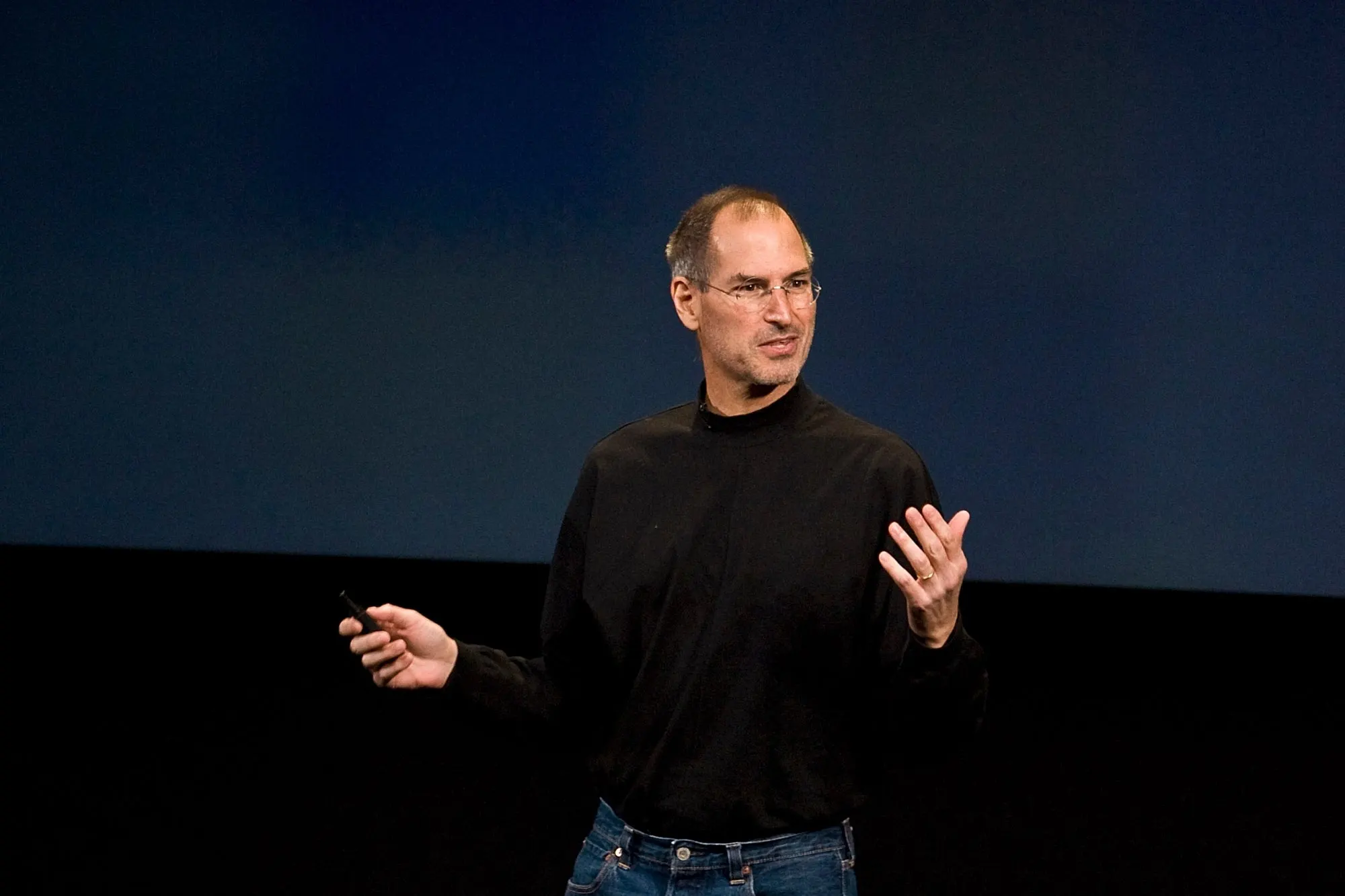
Introduction to Steve Jobs
Steven Paul Jobs was an American business magnate, industrial designer, investor, and media proprietor who fundamentally transformed personal computing, animated movies, music, phones, tablet computing, and digital publishing. Born on February 24, 1955, in San Francisco, California, Jobs co-founded Apple Computer in 1976 alongside his friend Steve Wozniak. Widely recognized as a charismatic pioneer of the personal computer revolution, his insistence on elegant design, tight integration of hardware and software, and relentless pursuit of perfection made Apple one of the most valuable and influential companies in global history.
Early Life and Education
Jobs was born to Joanne Carole Schieble and Abdulfattah “John” Jandali, and was adopted shortly after birth by Paul Reinhold Jobs, a machinist and coast guard veteran, and Clara Jobs, an accountant. The family settled in Mountain View, California, in an area that was rapidly transforming into the technology hub known as Silicon Valley.
From an early age, Jobs was exposed to electronics through his father’s workbench and neighborhood engineers. He attended Homestead High School in Cupertino, California, where he befriended fellow student and engineering prodigy Steve Wozniak. After graduating high school in 1972, Jobs enrolled at Reed College in Portland, Oregon. Finding the tuition a financial strain on his parents, he dropped out after a single semester. However, he remained on campus as an auditor, taking classes that interested him—most notably a calligraphy course taught by Robert Palladino, which later inspired the typography and variable-width fonts featured in the Macintosh computer.
Founding Apple and the Personal Computer Revolution
In 1974, Jobs returned to California and worked as a technician for the video game pioneer Atari, Inc. During this period, he visited India with a college friend to seek spiritual enlightenment, an experience that profoundly shaped his philosophy and minimalist aesthetic. Upon returning, he reconnected with Steve Wozniak, who was active in the Homebrew Computer Club.
The Apple I and Apple II
Recognizing the commercial potential of Wozniak’s home-designed computer circuit board, Jobs convinced Wozniak to form a company. On April 1, 1976, along with Ronald Wayne, they founded Apple Computer in the garage of Jobs’s childhood home. They released the Apple I as a bare circuit board for hobbyists, followed by the groundbreaking Apple II in 1977. Featuring an integrated keyboard, color graphics, and a finished plastic enclosure, the Apple II became one of the first mass-produced and commercially successful personal computers.
The Macintosh (1984)
Following a famous 1979 visit to the Xerox PARC research center, Jobs realized that graphical user interfaces (GUI) and mouse-driven navigation represented the future of computing. He took over Apple’s Macintosh development team, driving them to build an accessible, user-friendly computer. On January 24, 1984, Apple introduced the Macintosh, launched with the iconic “1984” Super Bowl television commercial directed by Ridley Scott. The Macintosh brought bitmapped graphics, desktop publishing, and intuitive software to the consumer market.
Departure from Apple, NeXT, and Pixar
Despite the Macintosh’s critical acclaim, internal friction mounted within Apple due to falling sales, intense competition from IBM-compatible PCs, and Jobs’s demanding management style. In 1985, following a power struggle with Chief Executive Officer John Sculley, Jobs was stripped of his operational duties and resigned from the company he had co-founded.
NeXT Computer
Shortly after leaving Apple, Jobs founded NeXT Inc. with $7 million of his own capital. NeXT produced high-end workstation computers designed for higher education and business markets. While the expensive NeXTcube was a modest commercial success, its object-oriented operating system, NeXTSTEP, was revolutionary. It served as the platform upon which Tim Berners-Lee invented the World Wide Web at CERN in 1990, and it eventually laid the structural foundation for Apple’s modern operating systems.
Pixar Animation Studios
In 1986, Jobs purchased the Computer Graphics Division of Lucasfilm from filmmaker George Lucas for $10 million, spinning it off as an independent company named Pixar. Initially selling high-end hardware like the Pixar Image Computer, the firm shifted focus to 3D computer animation under creative leader John Lasseter. In 1995, Pixar released Toy Story, the world’s first fully computer-animated feature film. The movie was a massive critical and box-office triumph, and Pixar’s subsequent public offering made Jobs a billionaire. The studio went on to produce consecutive hits including A Bug’s Life, Toy Story 2, Finding Nemo, and The Incredibles before being acquired by The Walt Disney Company in 2006 for $7.4 billion, making Jobs Disney’s largest individual shareholder.
Return to Apple and the Corporate Renaissance
By late 1996, Apple was facing severe financial distress and operating system obsolescence. In December 1996, Apple announced the acquisition of NeXT for $429 million, bringing Jobs back to the company as an advisor. In July 1997, after CEO Gil Amelio was ousted, Jobs was named interim chief executive (iCEO).
Jobs immediately instituted a dramatic overhaul of Apple’s strategy:
- Product Streamlining: Cancelled dozens of ongoing projects, including the Newton PDA, and reduced Apple’s complex product line to a simple four-quadrant matrix (Desktop vs. Portable, Consumer vs. Professional).
- Design Partnership: Promoted Jony Ive to lead Apple’s industrial design team, creating a legendary creative partnership.
- Think Different Campaign: Launched an award-winning brand campaign honoring historical iconoclasts like Albert Einstein, Martin Luther King Jr., and Mahatma Gandhi, restoring morale and brand identity.
- The iMac G3 (1998): Released an all-in-one translucent, colorful desktop computer that eliminated legacy floppy disk drives in favor of USB technology, selling nearly 800,000 units in its first five months and restoring profitability.
Era of Breakthrough Consumer Innovations
Under Jobs’s second tenure, Apple evolved from a niche computer manufacturer into a global titan of consumer electronics and digital services.
The iPod and Digital Music (2001–2003)
In October 2001, Apple introduced the iPod, a portable digital audio player carrying “1,000 songs in your pocket.” Combined with the launch of the iTunes Store in 2003, which allowed consumers to legally purchase single tracks for 99 cents, Jobs successfully transformed the global music industry and created an ecosystem that locked in consumer loyalty.
The iPhone (2007)
On January 9, 2007, Jobs delivered what is widely considered one of the greatest product keynote presentations in technology history, unveiling a device that combined a widescreen iPod with touch controls, a revolutionary mobile phone, and a breakthrough internet communications device into one product: the iPhone. Featuring multi-touch technology, a full web browser, and later the App Store (2008), the iPhone reshaped global telecommunications and catalyzed the modern smartphone economy.
The iPad (2010)
In April 2010, Jobs introduced the iPad, creating a brand new category of consumer device positioned between the smartphone and the laptop. Designed for media consumption, web browsing, and lightweight productivity, the iPad sold over 15 million units in its first year, establishing clear dominance in the tablet market.
Health Battles and Passing
In October 2003, Jobs was diagnosed with a rare form of pancreatic neuroendocrine tumor. Initially attempting to manage the condition through alternative medicine, he underwent surgery in July 2004 to remove the tumor. Over the following years, his health challenges continued, leading to a leave of absence in 2009 during which he received a liver transplant.
Despite declining health, Jobs remained actively involved in Apple’s key product unveilings until early 2011. On August 24, 2011, Jobs resigned as CEO of Apple, recommending Tim Cook as his successor and assuming the role of Chairman of the Board. On October 5, 2011, Steve Jobs passed away at his home in Palo Alto, California, at the age of 56.
Major Career Achievements and Legacy
- Co-Founding Apple Inc.: Helped turn a garage startup into one of the world’s most valuable public corporations and a global driver of digital culture.
- Commercializing the Graphical User Interface (GUI): Brought the mouse, desktop metaphor, and WYSIWYG (“what you see is what you get”) visual computing to the mass market via the Macintosh.
- Transforming Animated Cinema: Guided Pixar Animation Studios from a hardware division into an entertainment giant that defined modern 3D feature animation.
- Restructuring Six Major Industries: Disrupted and reshaped personal computing, animated movies, music distribution, mobile telephony, tablet computing, and digital publishing.
- Mastery of Industrial Design and User Experience: Championed simplicity, minimalism, and seamless hardware-software integration, setting universal design standards across consumer tech.
- Presidential Medal of Freedom: Posthumously awarded the United States’ highest civilian honor in 2022 for his transformative contributions to technology, design, and culture.